International Traveler: Coffee, Teas, Honey, Nuts, and Spices
[ Back ]
The United States restricts or prohibits the entry of many agricultural products, which can carry foreign pests and diseases that harm American agriculture and our environment. A major pest or disease outbreak could mean higher grocery bills, shortages of certain foods, and devastating losses for our farmers and ranchers. Help us keep American agriculture healthy by following the guidance on this page about products you may want to bring into the United States.

Are you traveling from Canada by Land? Find out which meat, poultry and pet food products that you CAN and CANNOT bring back to the U.S. from Canada's land border. Air travelers should refer to the guidance listed below.
Coffee, Teas, Honey, Nuts and Spices that you CAN and CANNOT bring back to the U.S. (choose below)
- Coffee (Roasted, Green, Whole, Seeds, Plant Parts)
-
USDA’s requirements for the entry of coffee/coffee beans carried by a traveler differ according to the specific form of the product and location of the port of entry:
- Roasted Coffee: Travelers are permitted to bring unlimited quantities of roasted coffee in their luggage without restriction through any U.S. port of entry. However, as with all agricultural products, you must declare the product at entry.
- Green (unroasted) Coffee Beans: Travelers are permitted to bring unlimited quantities of green coffee beans in their luggage without restriction through any port of entry in the continental United States; however, green coffee beans are prohibited from entering into or transiting through Hawaii or Puerto Rico. As with all agricultural products, you must declare the product at entry. If any quarantine pests are found in green coffee beans, the product will be seized and destroyed.
- Whole Coffee Berries (aka, coffee cherries): fresh coffee berries—defined as the unprocessed, whole coffee fruit with pulp—are prohibited entry at all U.S. ports of entry because the pulp presents an exotic fruit-fly risk.
- Green Tea, Black Tea
-
Travelers are permitted to bring without restriction any quantity of products composed solely of tea leaves (Camellia sinensis: includes black tea, green tea, oolong, dark tea, white tea, yellow tea). As with all agricultural products, you must declare the product at entry.
- Herbal Tea/Herbal Infusions
-
Products traveler CAN bring if commercially packaged/prepared (declare all at entry)
- Hibiscus flowers contained in herbal tea products are permitted entry, subject to inspection.
- Herbal tea products containing ginseng or goldenseal are permitted, subject to inspection, if commercially packaged and ready to be boiled, steeped, or microwaved in liquid.
- Commercially packaged herbal products containing lemongrass are permitted subject to inspection; please see the Spices section of this page for guidance on lemongrass that is not commercially packaged.
- Dodder (aka Semen cuscatae, Cuscuta chinensis, or tu si zi; Cuscuta japonica, or toshishi or tosaja) is permitted in herbal tea products if contained in individual, ready-to-steep tea bags and dodder is processed sufficiently for seed color to be gray.
- Herbal tea products containing citrus (Rutaceae) leaves, flowers, bark, roots, peel, or fruit are enterable if the product is commercially packaged and ready to be boiled, steeped, or microwaved in liquid, or if package is labelled as having undergone required heat treatment. Otherwise, entry is prohibited.
- Herbal teas containing bark from Prunus trees (apricot, cherry, peach plum, etc.) are enterable if commercially packaged and ready to be boiled, steeped, or microwaved in liquid, or if package is labelled as having undergone required heat treatment. Otherwise, entry is prohibited.
- Masala chai, if all components are finely ground, may enter any port except for Hawaii or Puerto Rico, subject to inspection. If not finely ground, please contact USDA’s Plant Protection and Quarantine Permit Services office at (301) 851-2046 to inquire about requirements.
- Roobios tea is permitted, subject to inspection.
RESTRICTED or PROHIBITED products containing herbal ingredients
- Coca leaves and khat (Arabian tea) are restricted as Federally controlled substances.
- Products containing bark derived from endangered plants protected under the Convention on International Trade in Endangered Species of Wild Fauna and Flora (CITES) are restricted. Please see https://www.cites.org/eng/app/appendices.php for mor information.
- Any product containing barberry (berberis) leaves or Prunus (apricot, cherry, peach plum, etc.) flowers is prohibited from entry.
- Honey
-
USDA regulates only honey and beeswax that is being imported for use as feed for bees in apiaries. Generally, travelers can bring in comb honey, royal jelly, bee bread, or propolis if it is intended for personal consumption.
For more information, contact the Food and Drug Administration Center’s for Food Safety and Applied Nutrition at (888) 463-6332.
- Nuts
-
Nuts are allowed entry if they have been boiled, cooked, ground, oven dried, pureed, roasted, or steamed. For guidance on whether certain nuts prepared in other ways (for instance, raw, blanched, or in shells/husks) may enter and under which conditions, please contact USDA’s Plant Import Information Line at 877-770-5990 (Toll-Free) or by email at plantproducts.permits@aphis.usda.gov
- Spices
-
Most dried spices can be imported except for orange, lemon, lime, and other citrus leaves and seeds, and many vegetable and fruit seeds. While not explicitly prohibited, we also advise against bringing lemongrass that is not part of a commercially packaged product into the United States. Lemongrass needs to be inspected for plant rusts, which could lead to Customs delays and possible seizure.
How Do I Declare Agricultural Items?
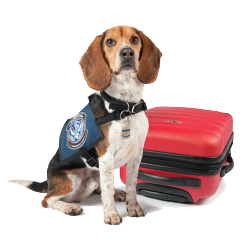
USDA-trained dogs help sniff out plants and animal products in luggage and carry-on items on international flights. Make sure you include any agricultural items on your Customs Declaration Form (select form below). This form provides Customs and Border Protection officials with basic information about who you are and what you are bringing into the United States, such as agricultural and wildlife products and whether you have visited a farm prior to traveling to the United States. When you declare, a U.S. Customs and Border Protection official can check your items. This is the only way to be certain that your items are free of plant pests and animal diseases.
Customs and Border Protection (CBP) Forms